
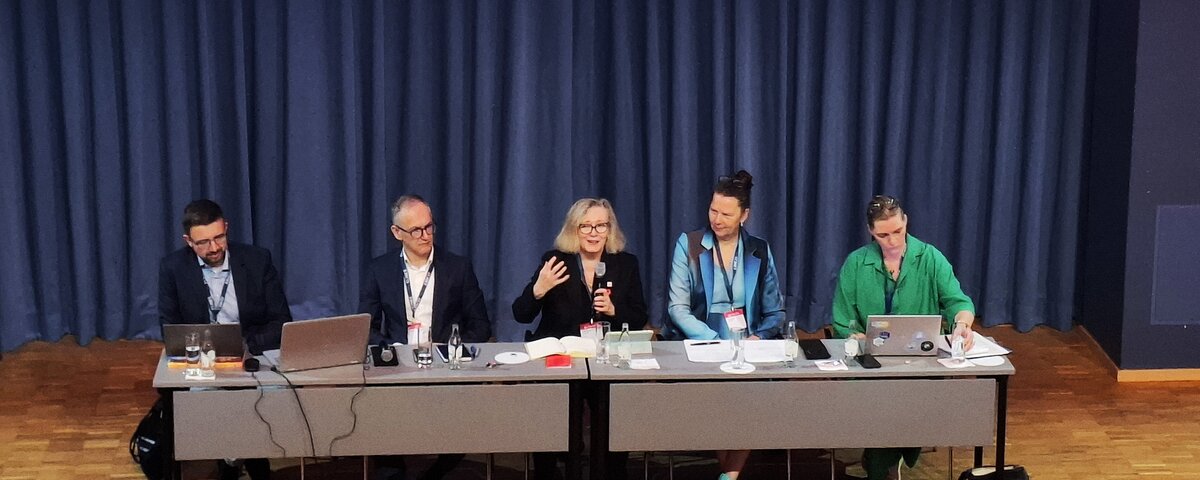
The Ibero-Amerikanisches Institut (IAI) participated in BiblioCon 2026 with an internationally composed panel discussion addressing key issues such as democracy, access to knowledge, and the responsibilities of libraries. The session, titled “International perspectives and strategies of libraries for free access to knowledge, transparency, and democracy,” took place on 21 May 2026 in the congress auditorium and was moderated by Christoph Müller (IAI).
International perspectives and strategic approaches
The discussion brought together leading representatives of international library associations: Sharon Memis (Secretary General, IFLA), Erna Winters (President, EBLIDA), Alexander Hasgall (Executive Director, LIBER), and Antje Theise (President, German Library Association – dbv).
Christoph Müller also took part as a representative of the IAI, actively engaged in international library committees and professional bodies. Since early 2026, he has served as Deputy Chair of the German National Committee of the International Federation of Library Associations and Institutions (IFLA). In his role on the board of the Association of German Librarians (VDB), he is primarily responsible for international affairs. In this capacity, he brings his experience in international library policy cooperation directly into professional exchange and strengthens the visibility of the IAI in the global library discourse.
The panel focused on the role of libraries in a rapidly changing political and social landscape. Particular attention was given to strategies for safeguarding free access to information, strengthening democratic structures, and responding to growing political pressure and the spread of disinformation.
Libraries as infrastructures of democracy
A central theme of the discussion was the role of libraries as fundamental infrastructures for democratic societies. Several contributions emphasized that, as non-commercial spaces, libraries provide open access to knowledge and actively support social participation.
Sharon Memis highlighted the global responsibility of libraries and stressed their importance as spaces of diversity, inclusion, and free access to information. In this context, the need to strengthen libraries as resilient institutions and to invest in their long-term sustainability was also underscored.
Christoph Müller built on these perspectives and referred to three key concepts anchored in the SPK/IAI Strategy 2030—Resilience, Relevance, and Reliability—which are regarded as essential prerequisites for the societal impact of library work.
Addressing political challenges and disinformation
Another key focus was how libraries can respond to political interference, censorship, and increasing pressure on library institutions. The discussion explored how libraries can maintain their role as open platforms while also dealing with discriminatory or anti-democratic content.
Erna Winters pointed out that libraries can create spaces where different perspectives are not set against each other but are made visible side by side. This ability to foster dialogue and mutual understanding was identified as a core strength of libraries in supporting democratic resilience.
Global cooperation and emerging challenges
The discussion made clear that many of today’s challenges—such as disinformation, the role of artificial intelligence, and issues of sustainability—can only be effectively addressed through international cooperation.
In this context, Alexander Hasgall highlighted the growing importance of new technologies, while also noting the increasing relevance of global collaboration and shared standards for access to knowledge.
The German perspective was also represented: Antje Theise emphasized the role of libraries in civil society and referred to initiatives that promote democratic values, for example in the field of educational and school libraries.
Cultural heritage, colonial contexts, and access
Another part of the discussion focused on the handling of culturally sensitive materials and collections originating from colonial contexts. It was emphasized that libraries are increasingly faced with the challenge of providing access to historical collections in a sensitive manner and in dialogue with communities of origin.
Existing guidelines and international recommendations provide important orientation in this area. At the same time, it was stressed that these processes are closely linked to issues of transparency, participation, and power relations within the global knowledge system.
Relevance for the IAI
The topics discussed are of particular importance for the IAI. As an institution with extensive collections relating to Latin America, the Caribbean, Spain, and Portugal, the institute is deeply engaged with questions of access to cultural heritage and the handling of culturally sensitive materials—especially in indigenous contexts.
Approaches that go beyond traditional perspectives on colonial-era collections are gaining in importance, placing stronger emphasis on participatory, context-sensitive, and responsible access strategies. International frameworks—such as the CARE Principles (Collective Benefit, Authority to Control, Responsibility, Ethics)—highlight the need to actively involve source communities and to acknowledge diverse knowledge systems.
These perspectives are central to the work of the IAI and are reflected both in the cataloguing and digitization of its collections and in its international collaborations and dialogue formats. The institute sees itself as a bridging institution that contributes to reflecting on global asymmetries of knowledge and promotes a sensitive and inclusive approach to cultural heritage.