Visiting the IAI
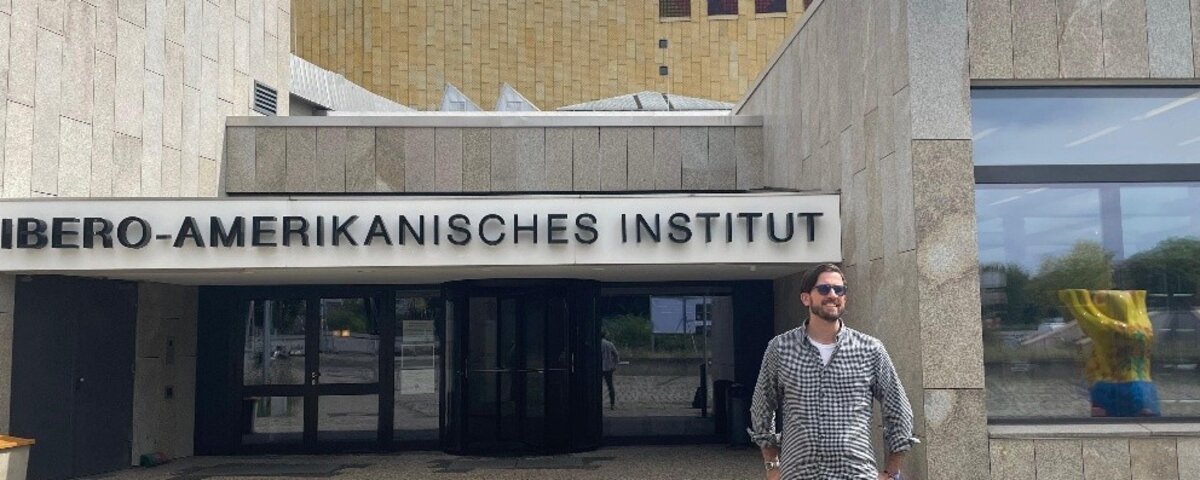
The Ibero-Amerikanisches Institut (IAI) is delighted to welcome Dr Matías Milia as a Mercator Fellow for the research project ‘TRANSUR: Transformed by the South. The Circulation of Latin American Social Sciences in France and Germany’. TRANSUR aims to conduct a comparative analysis of the circulation of Latin American social sciences in France and Germany from the 1950s to the present day. The project, funded by the DFG and the ANR, will run from April 2026 to March 2029.
Milia is a sociologist and currently works as a visiting lecturer in the Department of Sociology at the Universidad Autónoma Metropolitana, Azcapotzalco Campus (UAM-A), in Mexico City. His research lies at the intersection of sociology, Science and Technology Studies and digital methods. His work focuses on the relationships between digital infrastructures, scientific practices, forms of collaborative work and the circulation of knowledge. He combines quantitative methods of textual analysis and bibliometrics with digital and ethnographic approaches. He has previously worked in Argentina, Ecuador, Mexico, France and the United States.
Quantitative perspectives on reception and exchange
At TRANSUR, Milia is part of Work Package B, ‘Reception and Exchange’, which is dedicated to studying the reception and exchange of Latin American social sciences in France and Germany.
Whilst other members of the research team analyse these processes primarily from a qualitative perspective, Milia is responsible for the quantitative analyses. To this end, scientific publications and doctoral theses are collected and analysed using quantitative text analysis and bibliometric methods. This makes it possible to identify thematic structures, developments and scientific networks.
The findings are related to the qualitative research carried out as part of the work package, linking statistical patterns to historical, institutional and sociological contexts specific to the sociology of knowledge. In this way, their work helps to reconstruct how ideas originating in the Latin American social sciences were received, developed and contextualised in France and Germany.
“TRANSUR gives me the opportunity to broaden the scope of my work”
For Milia, one of the main strengths of TRANSUR lies in the opportunity to bring different disciplinary and methodological perspectives into dialogue. “As I see it, TRANSUR offers me, above all, a great opportunity to broaden the scope of my work,” he says.
Working in an interdisciplinary team allows him to connect his research agenda with that of colleagues who share his interests while also bringing interesting theoretical and methodological complementarities. “I think this has a lot of potential because it connects theoretical and methodological approaches with the empirical work that each of us has been doing, giving it a platform to develop and consolidate discussions and research agendas,” he explains.
Research and exchange at the IAI
During his stay in August and September, Milia was able to make use of the IAI’s research facilities, as well as its extensive library and archive collections. For a project focusing on the international circulation of knowledge, these resources are of particular relevance. At the same time, the visit provided an opportunity for exchange with researchers from the IAI and the international TRANSUR consortium.
The project brings together researchers from institutions in Germany, France and Latin America and examines the circulation of Latin American social sciences from three interrelated perspectives: institutionalisation, reception and exchange, and translation. This interdisciplinary approach combines, amongst other fields, the sociology of knowledge, intellectual history and Science and Technology Studies.
For Milia, the project also represents an opportunity to strengthen his work through dialogue with colleagues and to contribute to the social sciences, with relevance for both Europe and Latin America. “I also hope to be able to make contributions to the discipline, with relevance for both Europe and Latin America, by helping to examine the social, institutional and technical conditions that enable knowledge to circulate,” he says.