
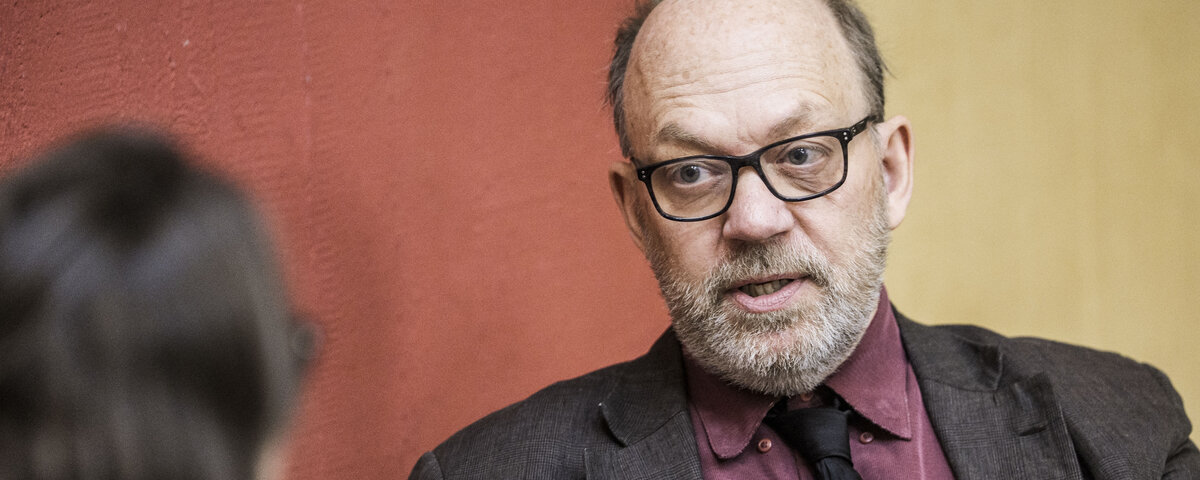
The rules-based order, international law, state sovereignty, the belief in universal equality: all of this, says Greg Grandin, was not conceived in Western Europe and the United States but
in Latin America. With America, América: A New History of the New World, the historian draws a line from the Spanish Conquista through the founding of the United Nations into our present. He reframes the continent, not as a victim of Western modernity but as its decisive architect. Grandin, born in 1962, teaches history at Yale University and received the 2020 Pulitzer Prize for The End of the Myth. The conversation took place in early June at an event hosted by the Ibero-American Institute (IAI) in Berlin in cooperation with the Einstein Forum Potsdam. The occasion was Grandin’s lecture launching the event series “We the People – Program Initiatives of the Prussian Cultural Heritage Foundation for the 250th Anniversary of US Independence.”
What should a young person from Berlin, Paris, or Madrid take away from your book that is not taught in European schools?
Of course I want them to grasp the significance of Latin America for the United States and the world order. But more important to me is an ethical argument: that politics is the realm in which humanity first comes into being.
It is political struggle through which people become both more human and more free, and not, as they are told, the market economy. Latin America was and is a place of enormous tragedy and violence, and yet many people there hold on to a fundamental definition of humanity, of social democracy, of universalism. There is great joy in that.
It is this political action through which we become less alienated, especially now, as we face the beast of artificial intelligence and are all about to be inscribed into algorithms. Being human is political struggle.
Your book is almost 800 pages. Imagine you have an elevator ride to sum it up for me, from the 30th floor to the ground.
(Laughs) My main argument is this: historians, political scientists, and legal theorists have viewed the Atlantic world as the origin of liberal internationalism, the rules-based order, and political liberalism. This book shows that you have to go further back, to the Spanish Conquista, to the slaughter, and to the reaction it provoked. That is where the beginnings of what we call political modernity lie: an egalitarian ethos, the belief in universal equality, and a direct line from the independence of Spanish America to the founding of the United Nations. Everything that came together in San Francisco in 1945 to form the liberal world order and the UN was already present in Latin America in the 1820s.
You draw a direct line from Bartolomé de las Casas, the sixteenth-century Spanish priest and first great critic of the Conquista, to the founding of the United Nations. That sounds bold.
De las Casas is often regarded as the founder of the idea of human rights. I consider him a more profound political thinker within the Catholic world. The Spanish Catholic Conquista was one of the first imperial enterprises that carried within itself the conditions of its own negation, because Catholicism claimed to be universal.
Many dissidents who witnessed the slaughter were forced to think through fundamental questions: Were the indigenous Americans human beings? Did they possess sovereignty? What was the right to rule? Out of this emerged a powerful critique of the Spanish Crown. The Conquista continued nonetheless.
But if you jump forward a few hundred years to the independence of Spanish America, its leaders drew on precisely those formulations. When the United States rose to become a superpower, annexed Texas, Mexico, and Florida, displaced indigenous peoples, and began to intervene in Latin America, Latin American jurists reached back to exactly these principles: sovereignty, dominion, property rights, human equality.
A critique that had been directed against Spain in the sixteenth century was updated by Latin American republicans and turned against the United States.
How did these ideas become the postwar world order?
Take a single principle: the doctrine of conquest. The early critics challenged it without being able to overcome it. When the independence leaders broke away from Spain, they abolished the doctrine. Seven independent republics on one continent had to learn to coexist.
The United States, by contrast, founded its sovereignty on a revived doctrine of conquest that justified its westward expansion and the annexation of Mexico. The sustained struggle against this expansion gave flesh and blood to the abstractions, the ideals of sovereignty. At the first Pan-American Conference in the early 1890s, Latin America explicitly tried to persuade the United States to recognize this doctrine as invalid. In vain. The US taught it as valid international law into the 1920s. Only under Roosevelt, in the 1930s, did they relent. And only that made the United Nations possible.
You call the book a summation of your work to date. Did anything surprise you while writing it?
I always try to preserve the capacity for surprise. There were things I simply did not know. Francisco Bilbao, for instance, the Chilean activist, whose life fascinated me. Or how precisely José Martí thought through the relationship with the United States. Then the significance of the years 1933 to 1943, the golden age of relations between the US and Latin America. And finally the last chapter on the assassination of Jorge Gaitán in Colombia. Less surprise than the pleasure of learning something new about Colombia.
What becomes possible if Europe truly takes your arguments seriously?
That is hard to say, because things are not going well in Latin America right now. Trump has, so to speak, overturned the table there. But there is still a degree of sociality that lies outside the machinery. There is a counter-reaction, not only to artificial intelligence but to the whole way technology is beginning to devour everything. In Latin America, right-wing politicians embrace AI, memes, the whole madness. And then there is someone like Mamdani, the mayor of New York, who rejected all of that and instead made very simple videos that create connections. There is hope in that. For all the destruction Donald Trump has wrought, perhaps hope can be found precisely there.
The Irish Times compares your style to the novels of Gabriel García Márquez. Who do you write for?
I try to embed academic arguments in stories, in narratives. That is a way to convey their meaning and to draw out the normative implications.
The Ibero-American Institute and the other institutions of the Prussian Cultural Heritage Foundation are renowned for their collections. Your books, too, are built on archives, on colonial records and diplomatic correspondence. What role can libraries and knowledge institutions still play today?
Hard to say. I have written books, The Empire of Necessity, The Last Colonial Massacre, The Blood of Guatemala, Fordlandia, that were deeply rooted in the archive. You go there, you do
archival work. But there are also books where I google archival portals and search online for access. The boundaries between the types of information, the archival material, the interpretive secondary sources, the ephemera, are blurring because of technology.
To close with culture rather than history: Puerto Rican superstar Bad Bunny, during his Super Bowl halftime performance in February 2026, named every country and territory of the American continent. It was a radically political act of visibility in the middle of a mega music show. Is visibility in art and music doing work right now that history and politics cannot?
Bad Bunny’s performance reached hundreds of millions of people, and it was an unreserved,joyful affirmation not just of diversity but of working-class diversity. The show opened with a sugarcane field as its set, with labor, and expanded from there into society, culture, and community. He drew clear lines between Puerto Rico and Hawaii, between colonialism and neocolonialism. Under Barack Obama, Lin-Manuel Miranda and Hamilton were the cultural flagship, multicultural and neoliberal, perfectly attuned to those years. Bad Bunny is something different: a post-neoliberal critique, a vision of America and its diversity.
This interview was conducted in English and editorially condensed.