
Key information
Duration:
01.01.2023 - 31.12.2026
Status: Ongoing
Project group:
Academics:
- Dr. Iken Paap
- Dr. Antonio Benavides Castillo (Centro INAH Campeche)
Coordination:
Cooperation Partners / Institutions:
Description
Starting point
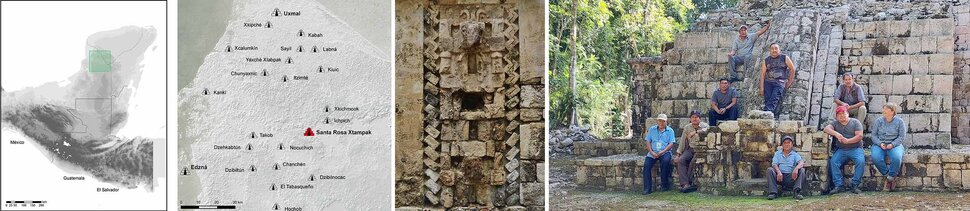
Santa Rosa Xtampak – located 26 kilometres east of the municipal capital of Hopelchén, Campeche – is one of the most important cities of the Classic Maya period in the centre of the Yucatán Peninsula. The architecture that still remains shows features of the Chenes and Puuc styles, as well as influences from the Río Bec and Petén regions.
The monumental centre of the archaeological site occupies a rectangular space measuring approximately 550 m by 400 m on the artificially levelled crest of a steep hill that rises 60 m above the surrounding landscape and forms part of a chain of hills stretching north to south for more than 30 km².
The densely built-up and terraced area of the surrounding site covers approximately 1 km². The total extent of the settlement – judging by the new LiDAR images available – could be as much as 10 km². To date, only a small part of the site has been recorded and studied in detail, including the three-storey palace, a huge pyramidal base, two other smaller pyramidal bases, a ball court, a causeway (sacbé) and several groups of buildings forming quadrangles around courtyards.
Our knowledge of the chronology of Santa Rosa Xtampak is based on the epigraphic analysis of seven stelae dated between 751 and 911 AD and two vault caps dated between 791 and 948 AD. Recent results from several stratigraphic excavations (2022) suggest an occupation of the site from the Middle Preclassic (1000-300 BC) to the Terminal Classic (750/800-950 AD). Isolated finds of Postclassic incense burner fragments indicate sporadic visits to the site during this period, but so far there is no evidence for a Postclassic occupation at Santa Rosa Xtampak.
Objectives
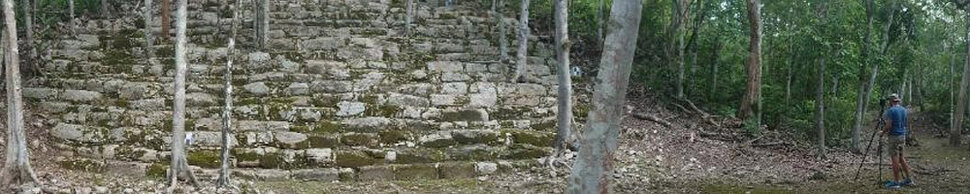
Since 2023, we have been engaged in clarifying open questions about details of the settlement's chronology (e.g., the Late Classic to Terminal Classic transition) and continuing the mapping of areas outside the monumental center of the site:
The results of analyses of surface finds and excavations at Santa Rosa Xtampak seem to reveal contradictions between architectural features and associated ceramics in two periods of the chronology:
A strikingly low representation of the Late Preclassic and Early Classic periods in the finds contradicts the relatively high number of buildings with so-called ‘megalithic’ architecture, which is considered an indicator of Late Preclassic and Early Classic settlements in the north of the Yucatán Peninsula. The results of the excavations show that both the common classification of all ‘megalithic’ buildings as ‘early’ and the concept of a 350-year-long Early Classic period in the study area must be viewed with scepticism in the future. Also striking is the occurrence of a type of architecture that is usually dated as Terminal Classic or Epiclassic – the C-shaped or bench-like buildings – appear to be exclusively associated with ceramics from the Late Classic period in Santa Rosa Xtampak.
Products
Presentations
Publications
Exhibitions
-
Auf den Spuren Teobert Malers - Archäologische Projekte in Campeche, Mexiko
IAI, Berlin, 16.10.2024-09.12.2024
-
Tras los pasos de Teobert Maler: dos proyectos arqueológicos en Campeche, México
Centro INAH Campeche, 24.10.2025-17.02.2026