
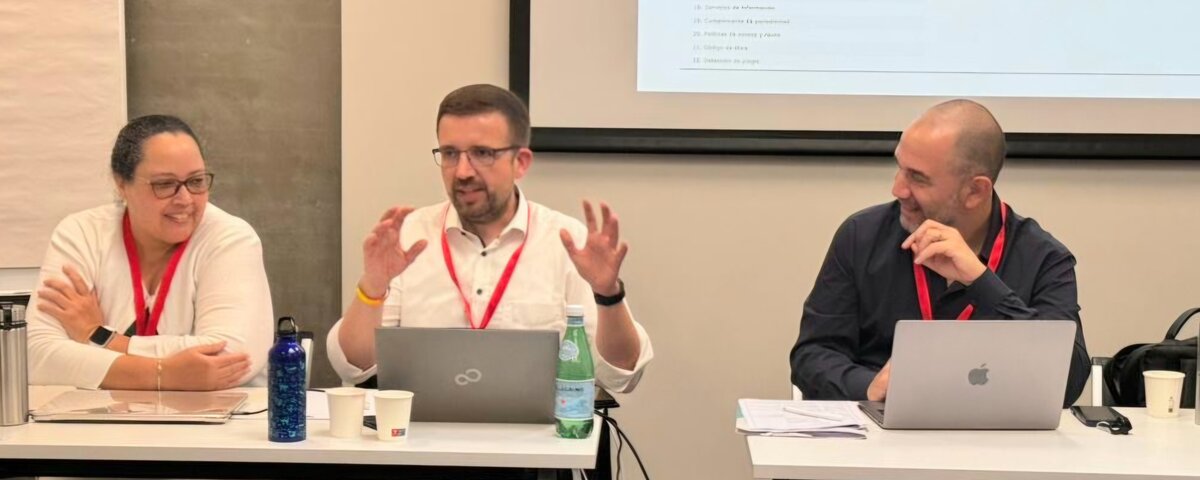
The Ibero-Amerikanisches Institut (IAI) participated on 28 May 2026 in a panel titled “Infraestructuras de información sobre América Latina y el Caribe en un mundo digital conectado”, held during the Latin American Studies Association (LASA) Congress in Paris. The session addressed key developments and challenges related to research information infrastructures for Latin America and the Caribbean in an increasingly interconnected digital environment and was conceived and coordinated by the Red Europea de Documentación e Información sobre América Latina (REDIAL) (external link, opens in a new window).
Information infrastructures in digital transformation
Against the backdrop of dynamic changes in research on the region, the discussion highlighted the growing need for specialized, multilingual, and interdisciplinary information provision. At the same time, open access and open science approaches are increasingly shaping research practices in Latin America and the Caribbean and directly affect the management and accessibility of research data. Libraries, archives, documentation centers, and museums are therefore required to provide digital services independent of time and location and to develop appropriate information infrastructures.
International cooperation and networks
A key focus of the panel was the importance of international cooperation. Networks and initiatives such as REDIAL, Latindex, dLOC, and CLACSO, as examples of many similar initiatives across Latin America, the Caribbean, Spain, and Portugal, play an important role in sharing resources, bringing together collections, and pooling specialized expertise. Collaboration among these actors opens up new opportunities for research and knowledge exchange and enhances the visibility of regional scholarly production.
Representing the IAI, Christoph Müller contributed to the panel. In his presentation, he outlined key developments in the field of information infrastructures and highlighted in particular the activities of the IAI, as well as the cooperation networks REDIAL and Latindex. He also organized the panel in his role as Vice President of REDIAL.
Other contributions included Pablo Vommaro (CLACSO (external link, opens in a new window)), who referred to current strategic initiatives, the Manifiesto de Bogotá (external link, opens in a new window), and the roadmap on Diamond Open Access adopted at an international conference in Bengaluru (external link, opens in a new window), as well as Stephanie Chancy (dLOC), who presented the cooperative approach, modes of collaboration, and the collections developed within the Digital Library of the Caribbean (external link, opens in a new window).
The panel provided an overview of existing cooperation networks and served as a platform for discussing future challenges, opportunities, and perspectives for collaboration in the field of information infrastructures for Latin America and the Caribbean.